
JUL
2026
Excited to join foundry10 as an HCDE Researcher!
Read more →
Excited to join foundry10 as an HCDE Researcher!
Read more →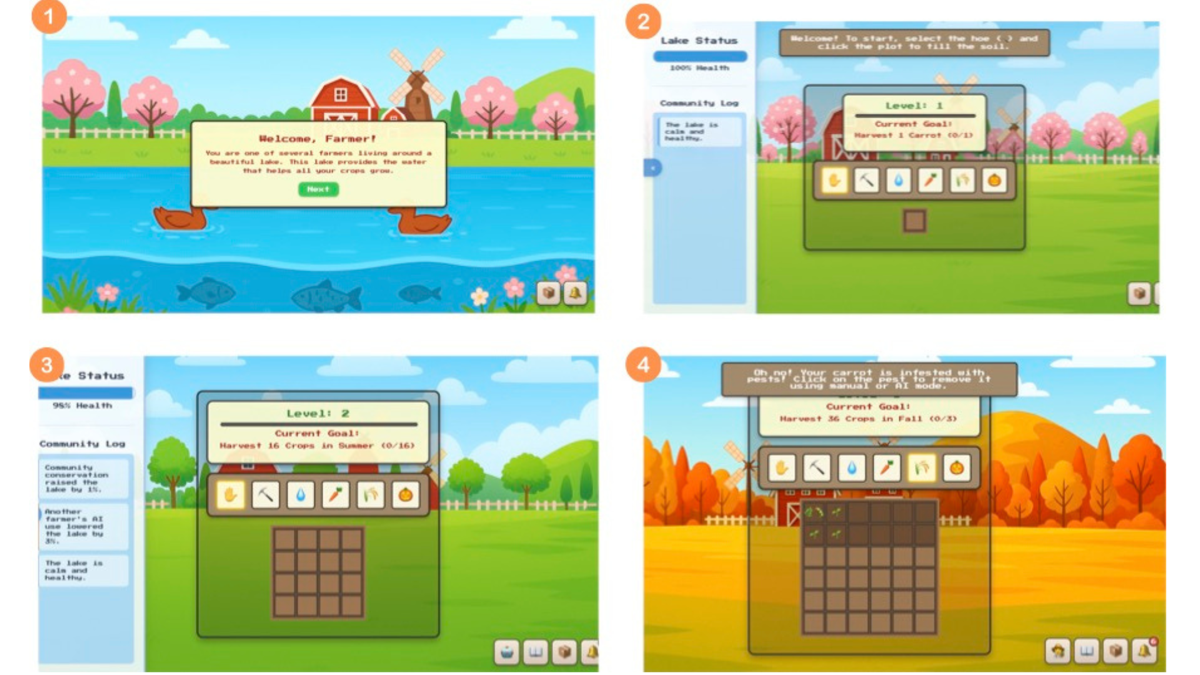
foundry10 features EcoPrompt, a tool I designed to help students think critically about AI’s environmental impact
Read more →
The Conversation publishes our work on AI inequalities in schools and the role of teachers
Read more →
Joan Ganz Cooney Center features my guest post on what children can learn from AI's mistakes
Read more →
Seattle Times reports on AI Puzzlers, a project I led to help kids understand AI’s limitations
Read more →
GeekWire reports on a research study I contributed to on AI portrayals of teens
Read more →Excited to join foundry10 as an HCDE Researcher!
Our paper on the future of expertise and the expert data gig economy received the Best Paper Award at CHIWORK 2026.
foundry10 published a story on EcoPrompt, a tool I designed to help students think critically about the environmental impact of AI.
Our design challenge submission won 1st Place at IDC 2026.
🎓 I successfully defended my Ph.D. dissertation in Human Centered Design & Engineering at the University of Washington.
Our paper has been accepted to DIS 2026 on value-oriented AI design.
Excited to co-organize three workshops on AI and children at IDC 2026 and to have two Late Breaking Work papers accepted to the conference.
Two papers accepted to IDC 2026. Looking forward to presenting in Brighton!
Received the OpenAI Mental Health Grant Award ($25,000) to support research on children and emotionally responsive AI systems. (Funding declined.)
Received the HCDE Doctoral Research Grant Award to support our work on Investigating Emerging AI Companions in Children's Play Environments with Meghna Gupta.
Successfully proposed my PhD dissertation and advanced to ABD (All But Dissertation) status.
Excited to co-author a piece in The Conversation with Katie Davis examining how generative AI could widen educational inequities and the critical role teachers play in shaping outcomes.
Gave an invited talk in the HCDE Research Speaker Series on designing interactive AI literacy systems.
Honored to receive two Special Recognition for Outstanding Review awards for CHI 2026.
Co-authored a BOLD (Jacobs Foundation) article examining the promises and risks of conversational AI for children’s wellbeing.
Wrote a guest post for the Joan Ganz Cooney Center (Sesame Workshop) on how children can learn from AI mistakes through playful, critical engagement.
Joined foundry10 as a research intern, designing studies on the integration of adaptive learning technologies in K–12 classrooms.
Two papers were accepted to the AAAI/ACM Conference on AI, Ethics, and Society (AIES 2025), including work on needs-conscious design and AI-mediated communication.
Featured on NPR’s Seattle Now (KUOW), where I discussed AI Puzzlers, a game I designed to help children recognize the limits and reasoning errors of generative AI.
AI Puzzlers was featured in The Seattle Times, highlighting how kids can outperform AI on certain reasoning tasks and what that reveals about AI literacy and learning.
My work on AI Puzzlers was featured in UW News, highlighting how children can outperform generative AI on certain reasoning tasks.
My research on children's AI literacy was featured in UW HCDE's Impact Research Series.
Presented two papers at IDC 2025 in Reykjavík: one on AI Puzzlers, a system that helps children spot errors in generative AI, and another on children's mental models of AI reasoning.
Presented our research at ISLS 2025 on designing an AI classification system for children with the learning sciences community.
Presented our research at CHI 2025 on designing AI tools to support parents in conducting speech therapy.
Joined Instructure (Canvas LMS) as a research intern, working on learning analytics and evidence-based evaluation of educational technologies.
Featured in GeekWire for our AIES research showing that AI language models disproportionately associate teenagers with negative behaviors.